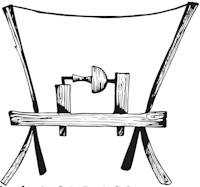

Yesterday we modified a lathe such that we could make small, thin objects on a pole lathe. However, the way the wood was held in the lathe’s axle left something to be desired. The axle had a round hole, and we clamped tapered, nearly round wood into it. And, perhaps predictably, this caused the wood to quickly slip in the axle with even a little resistance while turning. Today we made a small adjustment. A tapered, square piece of wood is clamped into a square hole in the axle. This helps! Now we no longer have a slipping problem, and the wood to be turned can also be carved square very quickly.


After another small test of the new setup, it was time for the first small, turned object: a lace bobbin. This also provided a good opportunity to practice with the skew chisel.

Although dozens of bobbins are often used in lace making, we only made one today.
The goal of this assignment wasn’t for Pieterjan to learn bobbin lace. The objective was twofold. First, to design and build a pole lathe suitable for turning small objects and to demonstrate its functionality. Second, to practice with the skew chisel and become proficient enough to turn small, thin objects. The finish, of course, had to be smooth, so that the fine lace thread wouldn’t snag on the bobbin. Both goals were achieved, as the photo shows!

Next on the to-do list was a spindle for spinning wool. So we’ll stay in the area of textiles for a while.

Many spindles are made of a round disc with a hole in the center, into which a long, thin rod is clamped. But they also come in a single piece, resembling a long, elongated teardrop. The trickiest part is the long, thin rod. Even the slightest pressure while turning causes this rod to bend slightly and vibrate. This results in a very rough finish.
One way to prevent this is to not only push against the wood with the chisel, but also to apply counter pressure by holding the wood with your hand. The photo below shows how this works.
With your left hand (if you are right-handed), guide the chisel with your thumb over the tool rest against the wood, while simultaneously holding your fingers lightly over the wood to be turned to provide counter pressure.

One issue we encountered was that the chisel’s tip could easily nick your fingers (see above). The solution was quite simple: grind the problematic chisel’s tip off.

The next item on the list of things we were going to make was a spinning top. This modified lathe proved to be very suitable for this purpose as well. It’s an easy-to-make toy that has provided entertainment for centuries.


After these spinning tops, we returned to a long, thin object: a spoon. Spoons can not only be carved by hand but also turned. The long, thin handle makes it difficult to do this on a pole lathe though. On the modified pole lathe however, this is no problem.
We started by roughly shaping the spoon with an axe. In this case, a long cooking spoon with a straight handle. Then, it was neatly finished on the lathe.

Not only has the handle been neatly rounded, but the outer shape of the spoon’s bowl has also been nicely shaped. Pieterjan has become quite adept with the chisel and, of course, has also added a few decorative beads to the spoon’s handle.


After turning, the spoon’s bowl is finished by hand with a knive. The back of the bowl is made slightly convex and the front concave, so you can not only stir but also scoop something up for tasting while cooking.
These first spoons took quite a bit of time to make. But we suspect that with more practice and increased efficiency, spoon turning could become much faster than carving by hand. Both options have their own charm and value however.
At the end of the day, there’s just enough time left to turn that one little thing that would have been better suited for the beginning of the project, but hadn’t gotten around to it then. Namely, a handle for a tool. In this case, a hammer. And while at it, we made a completely new hammer, since Pieterjan’s old one broke today.

