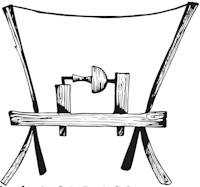

Part of our journey involves visiting other craftsmen who turn both contemporary and historical objects on the pole lathe. As there is an active community of these craftsmen in the UK, the journey takes us across the Channel.
Amy Leake
The first stop was in Hastings, where we were guests of Amy Leake (@woodmungler). Amy’s specialty is bowls with one or more handles, and it is exactly that challenge that we took on under her supervision. On a technical level, this visit was a very good preparation for a number of the following workshops that we were to follow in the UK, because when turning a handle on a bowl, the turning tool only hits air for a certain time during turning. This requires a lot of control over your tools and a stable position, where you do not push down on your workpiece, but really carve into thin air with your tool. This way of working ensures that you can achieve a very fine finish, much finer than when you push your hook into your workpiece and end up following your piece instead of determining a new, beautiful line.


The day was a good lesson in taking control over your tools and we were personally challenged to even finish that second bowl. We did the carving on the handle later, with the outline of the handle of one of Pieterjan’s bowls being drawn by Nico (@handgemaakt_geluk).
George Lailey
After Hastings came Bristol, but on the way we stopped at the Museum for English Rural Life in Reading. George Lailey’s lathe is exhibited here. Lailey was the last woodturner in England to produce on the pole lathe. He did this until he passed away in 1957 and for us this was a kind of pilgrimage to an important place in the history of the pole lathe.
In addition to this lathe, there were also other foot-powered lathes, such as a few great-wheel lathes.

Yoav Elkayam
In Bristol we were guests at Geoff Hannis’ (@treetotreen) workshop on the site of Grow Wilder, a CSA farm. Geoff opens his workshop to various craftsmen who currently do not have the space to do knowledge transfer, so we spent a few days in his workshop making objects under the watchful eye of various craftsmen.


First in line was Yoav Elkayam (@yoav.kafets), who taught us his method for turning plates. Turning a plate has 2 difficulties. On the one hand, you have the shallow profile which makes it difficult to turn very smoothly. Turning downhill is always easier to finish smoothly than turning flat. On the other hand, you have to remove a lot of material, but you should not do it all at once because then the piece might get wobly due the to thin shape of the plate when you exert some force to it with the turning tool. You want to maintain stability as long as possible, in order to get a good finish. It was interesting to see how the finesse we learned earlier with Amy already came in handy here.
Jack Labanowski
The second in line was Jack Labanowski (@jack_labanowski). Jack makes cups that have an axe finished outside and bowls with a pouring spout. In one day we made both objects thanks to his expert explanation. stop turning was discussed here for the first time. This is a technique that is specific to the pole lathe and cannot be done on a modern electric lathe. You turn to a certain point, then return and turn to that point again. You do this on both sides and in this way you get an object that is turned for example 80% and still has a small piece of wood that protrudes. In this case that becomes the pouring spout.


