
Geoff Hannis
The third and final day in Geoff’s workshop, with his expert explanation we turned a life edge bowl, with the bark on the top edge off the bowl. Normally you turn a bowl upside down, so the edge of the bowl is on the inside of the tree. Turning it upside down produces very nice, irregular results, especially with irregular pieces of wood.
With this type of bowl, it is a technical challenge to get a nice even surface by having good control over your tools. At the top of the bowl one carves wood and then the tools travels through air repeatedly. It is important not to move the tool in the air, because otherwise it will not carve the next piece of wood decently. This is where the practice with Amy comes in handy again.


In the afternoon we went from the bowl lathe to a spindle lathe to gain more insight into the workings of a skew chisel. We turned eggs and acorns to get to know this tool better and to understand when and why it can go wrong. Sharp tools are a big part of the job. That is the case with hook tools, but definitely with a skew chisel.
Colin Wells
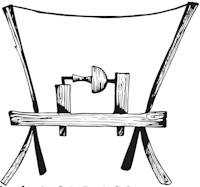
After Bristol our journey continued to Amberley, where we visited the open air museum. Not only one van visti all sorts of historical workshops, but some of the crafts can even be practiced, such as making a stool on a pole lathe. We did this there at Colin’s, where we made a very basic stool, with turned legs.


